
Climate change is no longer a distant concept for children. It shapes the air they breathe, the water they drink, and the environments they grow up in. Yet climate education is still uneven, especially in early learning spaces where foundations are formed.
Climate Heroes is a programme designed to introduce climate and environmental learning to children aged 3 to 11. The programme includes one year of implementation support, while schools can retain lifelong access to the curriculum and are encouraged to continue using it well beyond the support period.
Between May 2025 and April 2026, the programme reached 11,497 children across 63 low-fee community and government schools in India, Tanzania, and Kenya, training 185 teachers along the way. Earth Warriors works through and with five partners committed to strengthening early education systems: the Directorate of Education, Delhi; Akanksha Foundation; Hippocampus Learning Centres; Tanzania Early Childhood Education and Care (TECEC); and the Madrasa Early Childhood Programme in Kenya.
We started with baseline monitoring to understand where teachers and children were starting from. A year later, our endline evaluation shows what changed — and the early childhood data tells a particularly compelling story.
Together, we support teachers with curriculum, training, and classroom resources that help them teach climate change, environmental care, and sustainability in ways young children can understand and act on.
Why We Built It This Way
Much of climate education globally is built to transfer knowledge, not to build agency — and there is limited practical evidence on how to design learning that helps children move from understanding climate change to acting on it, especially for children as young as three. Most of the existing evidence also comes from high-income countries; very little comes from the government and low-fee schools of the Global South, where most of the world’s children learn.
Climate Heroes was designed from the outset to close both gaps: to build agency alongside knowledge, and to measure the full chain — from delivery, to learning, to action — rather than stopping at knowledge gains. Our theory of change follows that chain: a contextually relevant curriculum, teacher training, and ongoing mentoring were designed to produce confident teachers and completed lessons; those, in turn, were designed to build children’s knowledge, help them identify practical actions, and connect them with nature; and ultimately, to help children adopt pro-environmental behaviours themselves and carry them into their families.
How the Programme Was Delivered
Each partner received Earth Warriors’ curriculum and delivered weekly 40-minute lessons across the academic year, taught by each school’s own teachers. Training was delivered in two ways: Akanksha and Delhi teachers were trained directly, in person, by the Earth Warriors team, while Hippocampus, TECEC, and Madrasa used a train-the-trainer model, in which master trainers were trained online and then led full-day in-person trainings for teachers themselves. Partners also received localised Activity Packs — contextualised lesson plans, case studies, and hands-on activities connecting global climate concepts to children’s everyday experiences in each setting.
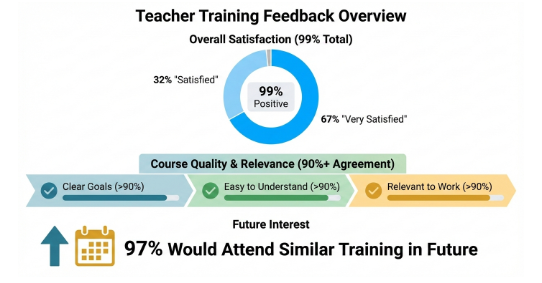
All 185 teachers were trained, and satisfaction was extremely high: 99% were satisfied, and 97% wanted to attend similar training again. Curriculum completion varied by partner — over 90% at two partners, 85% at another, and around 70% at Hippocampus — while Delhi’s 30-lesson curriculum was shortened to 20 lessons, of which teachers completed 15. One clear lesson emerged: teachers trained directly implemented the curriculum with more confidence than those trained through the cascade model, and Earth Warriors is now prioritising direct training wherever feasible.
What We’re Seeing: Teachers
Teachers are ready and motivated. At baseline, 41% had no concerns about teaching environmental issues and 44% had no concerns about climate change; among those who did, the main worries were that students were too young, limited classroom time, gaps in their own knowledge, and fear of making students anxious. Around half of teachers in India and Africa reported experiencing major effects of climate change personally or within their own communities, with air pollution the most widely shared concern, followed by climate change itself and water or soil pollution.
Baseline knowledge showed real room to grow: while most teachers understood that human activity contributes to climate change, only 63% could correctly define climate change, and just 42% could correctly explain the greenhouse effect.
By endline, teachers’ own knowledge and confidence to teach this material had clearly grown, moving from “moderate” to “high” across every topic area. Over 90% found the needed materials easy or fairly easy to source, and over 95% said the curriculum gave them what they needed to plan lessons well — confirming that the gap was never willingness, but time and structured support. Teacher feedback also directly shaped delivery: Delhi teachers asked for training earlier in the academic year, before pressure to complete core syllabi builds, and this has already been incorporated into the programme’s next phase there.
What We’re Seeing: Children, By Age
Before classroom delivery began, Earth Warriors ran baseline assessments across three age groups — Pre-primary (3–5), Grades 1–3 (6–8), and Grades 4–5 (9–11) — each administered orally, one-on-one, by teachers themselves.
Pre-primary (ages 3–5): Most children could already answer basic questions about environmental behaviours and relationships between living things, pointing to a strong early foundation shaped by home and school alike. Where there was still room to grow, the endline gains were striking: at Akanksha, understanding that people need plants rose from 81% to 97%; at TECEC, recognising a picture of Earth rose from 30% to 85%. TECEC did see a small dip on some questions, coinciding with school disruptions during Tanzania’s elections — a reminder that early years progress is sensitive to real-world disruption, not just curriculum quality.
Grades 1–3 (ages 6–8): At baseline, students answered around 40–60% of questions correctly on average — general environmental awareness was relatively strong, but climate-specific knowledge was limited, and fewer than half had even heard of “climate change.” By endline, average scores across this age group rose from 51% to 68%, with the biggest jump in basic climate awareness itself — from a low of 19% in Delhi to 100% by the end. Delhi government schools alone gained 42 percentage points, catching up fully to peer partners who had started far ahead.
Grades 4–5 (ages 9–11): Baseline scores here were 50–70%, with confident everyday pro-environmental habits but weaker grasp of climate-specific concepts. By endline, this was the strongest-performing group in the whole programme: scores rose from 59% to 85%, with endline scores across partners converging tightly between 82% and 88% despite very different starting points. Even the hardest concepts — like how trees absorb carbon — improved, though they remained the most difficult, suggesting these ideas need more time and repetition than a single year allows.
A small gender gap in learning outcomes was visible at baseline and widened slightly with age: 2 percentage points among pre-primary children, rising to 4pp in Grades 1–3 and 6pp in Grades 4–5 — a pattern worth tracking as the programme scales.
Teachers believe climate education is important.
The vast majority said it is important or very important for students to learn about climate and environmental topics.
58% strongly agreed and 39% agreed that the training content was relevant to them.
From Knowledge to Action
Perhaps the most important shift wasn’t in what children knew, but in what they could imagine doing. Asked with no prompts to name real ways to help the environment, children’s ability to do so rose from 64% to 75% in Grades 1–3, and from 68% to 95% in Grades 4–5. More tellingly, what they said changed in kind: baseline answers clustered around two ideas — plant trees, save water — while endline answers were specific, varied, and local, ranging from reducing plastic and using public transport to organising community clean-ups.
Age shaped the shape of that agency. Our youngest learners (3–5) named concrete, doable actions: “closing the tap to save water,” “throwing waste in the dustbin.” Grades 1–3 children started thinking about influencing others: “educate others about global warming,” “use public transport.” By Grades 4–5, children were reasoning like young systems-thinkers, connecting causes to effects and naming solutions like renewable energy, stopping industrial waste, and even “making laws for protecting Earth.”
Roughly 40% of early-years lessons and 27% of primary lessons were deliberately held outdoors to build not just knowledge but an emotional connection to nature. Teachers noticed real shifts in attitude — though this kind of change likely needs more than one year to properly measure, and Earth Warriors treats it as an early, promising signal rather than a settled finding.
Did It Reach Beyond the Classroom?
Over 80% of children (88% among the older group) told their families what they’d learned. Teachers and parents shared striking examples: one child refused to let their family keep dumping waste in a river, insisting it go to a collector instead; another group of students convinced local waste collectors to separate wet and dry waste. These are stories relayed by teachers and parents rather than independently measured — confirming lasting behaviour change at home is harder to prove than classroom learning, and Earth Warriors plans to measure it more rigorously next phase through parent and child focus groups.
What Children and Teachers Told Us
Feedback was consistently positive across every age group: roughly 90% of children said they want to continue Earth Warriors lessons next year, and over 80% rated lessons 4 or 5 out of 5 (74% among Grade 4–5 students specifically). On the teacher side, over 85% were satisfied or very satisfied with the programme overall, 88% agreed their own school should continue it (rising to 96% in Delhi and 100% at Madrasa), and 90% said other schools should adopt it too.
Scale and Sustainability
The strongest endorsement of the programme is what happens next: four of five partner organisations have shared plans to sustain or expand implementation. The Delhi Directorate of Education has issued a formal notice that the Earth Warriors curriculum will be implemented alongside Rashtraneeti, a government-mandated subject — giving it a guaranteed timetable slot rather than adding to teachers’ existing loads — and implementation there is expanding from 10 to 40 schools next year. In Kenya, Madrasa Early Childhood Programme schools requested a mid-year expansion to an additional 30 schools, with plans to integrate Earth Warriors content into other subjects for longer-term sustainability. Akanksha Foundation and TECEC intend to continue with interested schools, and discussions with Hippocampus are ongoing.
Key Takeaways for Early Childhood
The data points to a strong foundation for climate education in the earliest years. Teachers across India and Africa were motivated, open to learning, and already saw environmental education as central to their role — and their own lived experience of climate impacts made the training immediately relevant to them. Children as young as three brought real curiosity: 14% of teachers said students often ask about climate or environmental issues on their own, and 61% said they sometimes do.
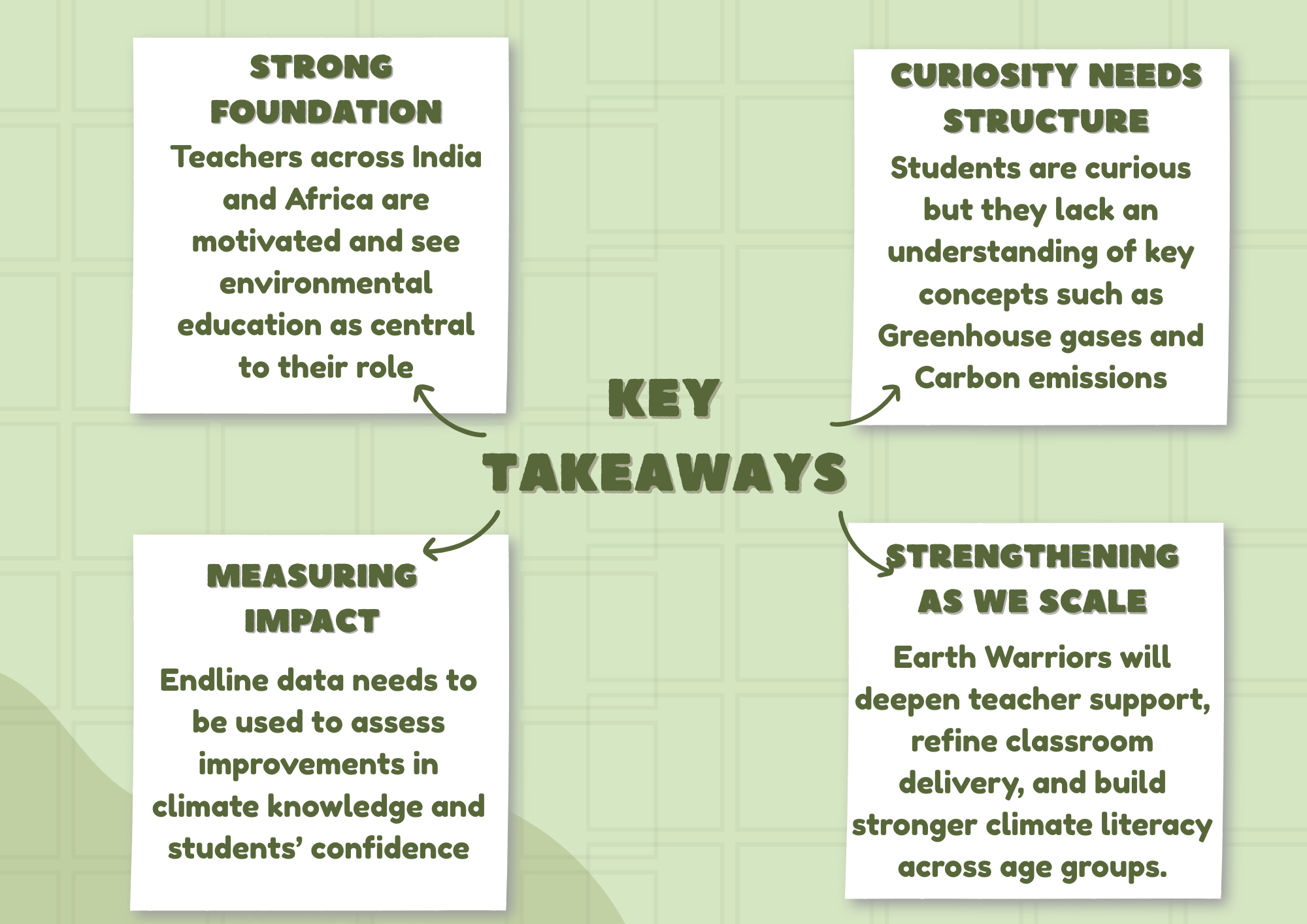
At the same time, the evidence is honest about its limits. This is a programme learning evaluation, not a controlled impact study — it doesn’t isolate the programme’s effect from other influences on a child’s learning. Teacher survey response rates were lower for our ECD-focused partners specifically (just 12% at TECEC and 19% at Hippocampus at endline), and our in-person focus group discussions were only conducted with India-based partners. So while the early years findings are genuinely promising, our confidence in the Kenya and Tanzania data is more provisional than in the India data — something being built directly into next year’s evaluation design, alongside lesson observations and post-training teacher quizzes.
Across every age group, though, one pattern held: children already care about the environment, but their understanding of climate change specifically is much less developed at the start — and structured, age-appropriate education, delivered with real teacher support, can close that gap within a single year, even for children just three years old.
The complete year-long evaluation — including full grade-by-grade breakdowns, partner-by-partner results, and lessons for policymakers, practitioners, and funders — is available in our full impact report: [link to Climate Heroes in the Making — Global Impact Report]
As Climate Heroes scales, Earth Warriors Global continues strengthening teacher support, refining classroom delivery, and building the deeper climate literacy children need to understand their world and act within it — starting from the very first years of school.