
Climate change is no longer a distant concept for children. It shapes the air they breathe, the water they drink, and the security of the world they’re growing up into. Yet most climate education still starts too late. It is built for teenagers who can already read complex texts and debate abstract policy. Our youngest learners, the ones forming their understanding of the world for the very first time, are largely left out of the conversation.
This isn’t a small oversight. The early years, roughly ages three to eight, are when children build their foundational sense of how the world works: that actions have consequences, that living things depend on one another, that they themselves can act and change things. Values, curiosity, and habits formed in this window can shape how children relate to the natural world for years to come. Waiting until secondary school to introduce climate education means waiting until after a child’s core attitudes toward the natural world have begun to settle. It also means missing the years when children are naturally the most curious, the most open to wonder, and the least burdened by the fear or fatalism that climate change can bring later on. Introduced early and gently, through stories, play, and direct experience with nature rather than statistics and warnings, climate education has the chance to build genuine care and agency instead of anxiety.
At Earth Warriors Global, a social enterprise creating climate education resources for children aged 3 to 11, we’ve spent the past several years testing this idea directly. We have been building the evidence that young children are not only capable of engaging with these ideas, but are often already asking the questions themselves. This is the story of what we built to put that belief to the test, beginning in Southern Africa and growing into a multi-country evidence base on climate education in the early years.
Where It Started: Botswana and Zambia
Our early years work began in 2023 in some of the most resource-constrained settings we’ve operated in: 10 schools in Botswana and 10 in Zambia, delivered through partners including Impact Network and Zambia Open Community Schools (ZOCS). Many were community schools serving vulnerable children in rural and peri-urban areas. They were often run by volunteer teachers, with no wifi, and materials had to be printed and physically carried to reach classrooms.
We chose these countries deliberately. Both are already living through the effects of climate change: prolonged drought, delayed rainy seasons, and rising heat that is directly affecting the agriculture large parts of the population depend on. According to the latest demographic data, 41% of Zambia’s population is under the age of 15, while 31.6% of Botswana’s population falls into this same young age bracket.[1] The stakes of getting early climate education right, and the potential for real, generational impact, are especially high.
We started with listening, not lesson plans, spending months with national and local networks, visiting schools, and sitting down with curriculum leads, headteachers, and teachers. Children and teachers already had a lived understanding of climate change. They could see it in their fields and their weather, but lacked the vocabulary and scientific grounding to name what they were observing. So teacher training added dedicated sessions on the foundational science of climate change. Activities were designed around materials already at hand, with corn covers, sticks, and stones standing in for anything purpose-bought. Low-cost and no-wifi wasn’t a constraint to design around, it was the baseline to design for.
From there, we contextualised a full 30-lesson curriculum per age group and developed four baseline questionnaires (one for teachers, three for different student age groups) customised for the technology, classroom size, and context of each school. Teachers were trained to administer these themselves, including how to sample randomly and record answers without bias, so the evaluation process built local capacity alongside the curriculum. By the programme’s kickoff phase, we’d run three teacher trainings, signed MOUs with all 20 schools, and collected baseline data on climate knowledge and attitudes in these communities. This early work taught us something that has shaped everything we’ve built since: climate education succeeds when the core learning objectives stay consistent, but delivery, training, materials, and pacing all bend to fit the world children are actually learning in.
By endline, the change was clearest among our youngest learners. Among 169 children aged 3 to 6 across Botswana and Zambia, 95% said they wanted to protect animals and plants, up from 62% at baseline. They reasoned about it in their own terms: some through kinship (“they are our friends”), some through consequence (“so that the mother earth can’t die”), and some through a practical sense of interdependence with animals and plants as sources of food. The share who said they knew how to protect them rose from 56% to 81%, and most could back it up with a real example, like not cutting down trees.
Foundational knowledge moved just as much. The share of children who could correctly identify a picture of the Earth rose from just 13% to 74%. Those who could articulate that what they breathe in and out is air rose from 25% to 58%. And over 90% agreed that we share our home with animals and plants, up from 66%. The full findings are in our Endline Report [2]
What these numbers point to is less about climate literacy in the abstract, and more about a felt sense of belonging to a shared world: that the Earth is a real, identifiable thing, and that animals and plants are neighbours worth protecting rather than background scenery.
Scaling the Approach: Climate Heroes in the Making
That same thinking, tested and refined in Southern Africa, became the foundation for Climate Heroes in the Making. This year-long programme ran from May 2025 to April 2026 across 63 schools in India, Kenya, and Tanzania, reaching 11,497 children and training 185 teachers.
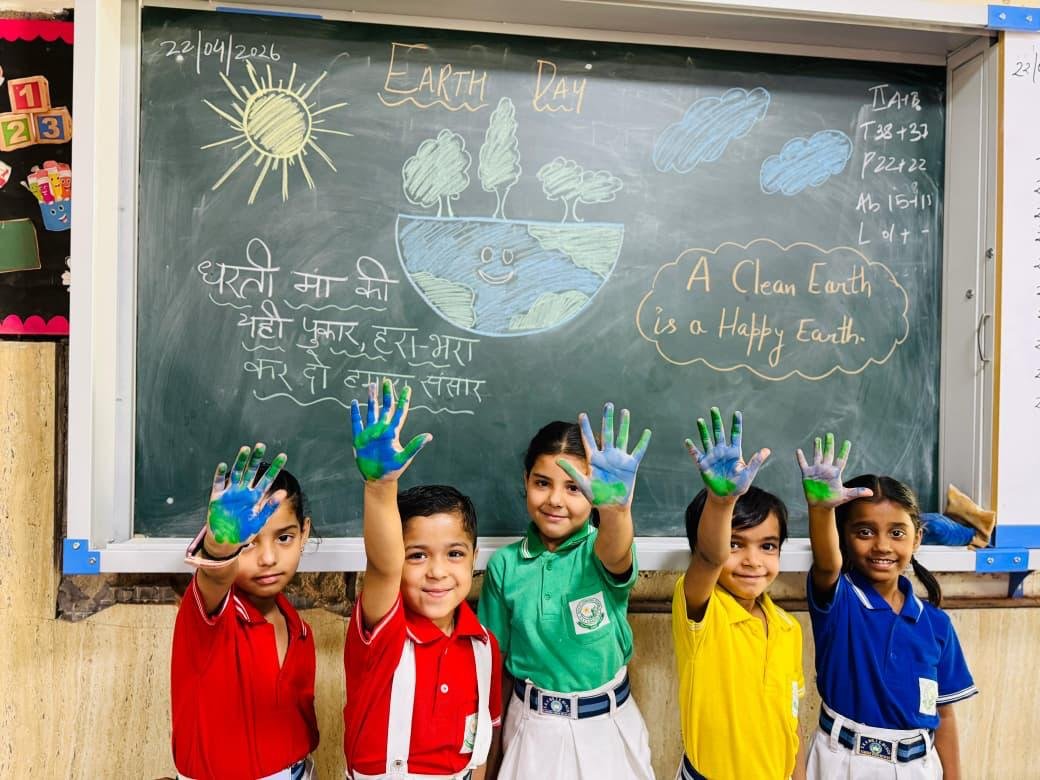
For our youngest learners, aged 3 to 5, lessons stayed experiential by design: storytelling, role play, outdoor observation, and hands-on activity, delivered in short, age-appropriate bursts. Around 40% of pre-primary lessons included outdoor, observation-based or nature-connected activities.
Across the three partners serving this age group, Akanksha (India), Madrasa (Kenya), and TECEC (Tanzania), 200 children were assessed at baseline and 155 at endline. Overall scores rose at Akanksha (89% to 93%) and Madrasa (75% to 88%). At TECEC they dipped slightly (80% to 73%), most likely because of school closures during the election period in Tanzania.
Children already showed strong environmental awareness before the programme even started, which left less room for scores to climb. Even so, clear gains emerged. At Akanksha, knowing that people need plants to live rose from 81% to 97%. At TECEC, identifying a picture of Earth rose from 30% to 85%, even as overall scores dipped. At Madrasa, a water-conservation question rose from 67% to 92%.
What It All Adds Up To
Across two continents, five countries, and settings ranging from rural community schools without wifi to busy city classrooms, a consistent pattern has emerged. Young children don’t need to wait until they’re older to start engaging meaningfully with climate change. There’s a real reason not to make them wait: the earliest years are when values are formed, curiosity is at its highest, and children are still open enough to build genuine care for the world rather than fear of it. Given age-appropriate material, real teacher support, and learning that’s hands-on rather than abstract, even a three-year-old can build a genuine foundation of environmental understanding.
For others working in early childhood, a few lessons stand out. Keep learning objectives consistent, but let delivery, materials, and pacing adapt to each setting. Train teachers in science, not only pedagogy, because their confidence shapes what children receive. Design for what is already in the classroom and the community, from sticks and stones to the local weather. And meet children’s curiosity with real answers, framed around what they can do.
What Botswana and Zambia taught us about designing for context, and what Climate Heroes in the Making later showed across more settings, points to the same conclusion: early childhood isn’t too soon to start climate education. It’s the ideal place to begin. And the earlier that foundation is laid, the more every year of learning after it has to build on.