
Part 2 of a series on climate education, green skills, and the next generation
In Part 1 of this series, ‘The Future of Work Is Changing. Are Children Ready to Meet It?‘, we looked at how sustainability is changing the world of work, why young people care about the planet without seeing a future for themselves in climate-related work, and why the early years matter.
In this post, we look at what young people actually need to learn.
The answer goes beyond green jobs. It is about green skills: the knowledge and abilities people need to make choices that are better for the planet, whatever work they do.
Let’s look at the numbers
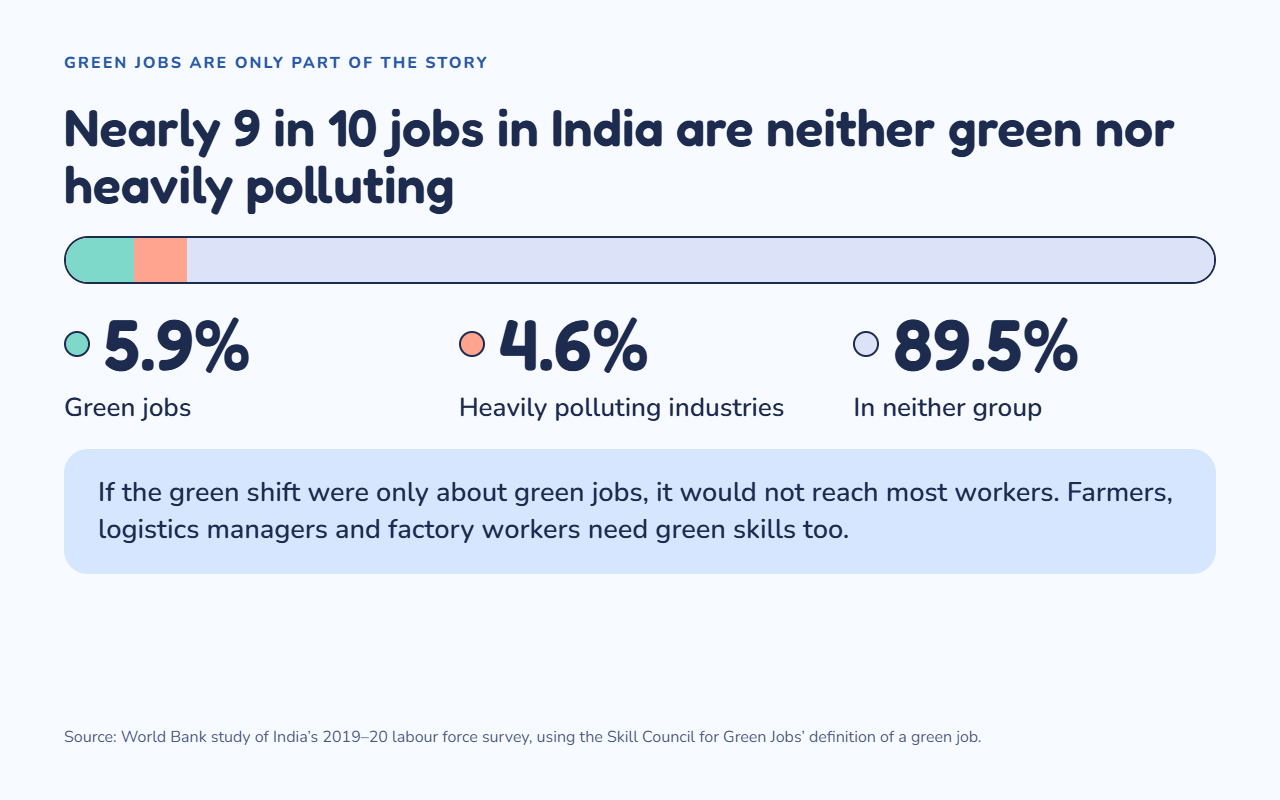
A World Bank study using India’s 2019–20 labour force survey found that just 5.9% of jobs in India met the definition of a green job used in the study. Another 4.6% were in highly polluting industries. The remaining 89.5% fell into neither category.
What does this tell us?
If preparing young people for climate action meant training them only for green jobs, we would be missing most of the workforce.
Green jobs are growing. IRENA and the ILO estimate that at least 16.6 million people worked in renewable energy worldwide in 2024. But these jobs represent only one part of the shift towards a greener economy.
The World Bank makes a similar point. Green skills are not just for scientists and engineers. A farmer who saves water, a factory worker who helps build electric vehicles, and a manager who finds ways to reduce waste all use skills that can support a greener economy.
Green skills are relevant across the workforce. A farmer who conserves water, a factory worker who helps build electric vehicles, an architect who designs energy-efficient buildings, and a manager who reduces waste all contribute to a greener economy in different ways.
The job itself does not have to be green for the skills to be. What matters is understanding how work affects the environment and finding ways to make it more sustainable.
What counts as a green job?
The International Labour Organization (ILO) defines green jobs as decent jobs that help protect or restore the environment. This means work that contributes to goals such as reducing pollution, saving energy, protecting nature or tackling climate change, while also providing fair pay and safe working conditions.
Some examples are easy to picture:
- A solar technician installing solar panels.
- An engineer designing buildings that stay cool while using less energy.
- A farmer using methods that save water and protect the soil.
- A waste management worker helping materials get reused or recycled.
- An environmental scientist working to restore damaged ecosystems.
Your job doesn’t have to be green. Your skills can be.
Think about an architect designing a building.
The job itself is not new. But today, an architect may need to think about how much energy a building uses, how to keep it cool in extreme heat, whether its materials create a lot of pollution, and how well it can withstand floods.
The same applies to many other professions.
A fashion designer can choose materials that last longer and are easier to reuse. A financial analyst can consider how climate risks affect a business. A software engineer can look for ways to reduce the energy used by digital systems. A supply chain manager can find ways to cut waste and emissions.
The job title might stay the same. What changes is how the work gets done.
Green skills help people bring the environment into the decisions they make every day.
So, what are green skills?
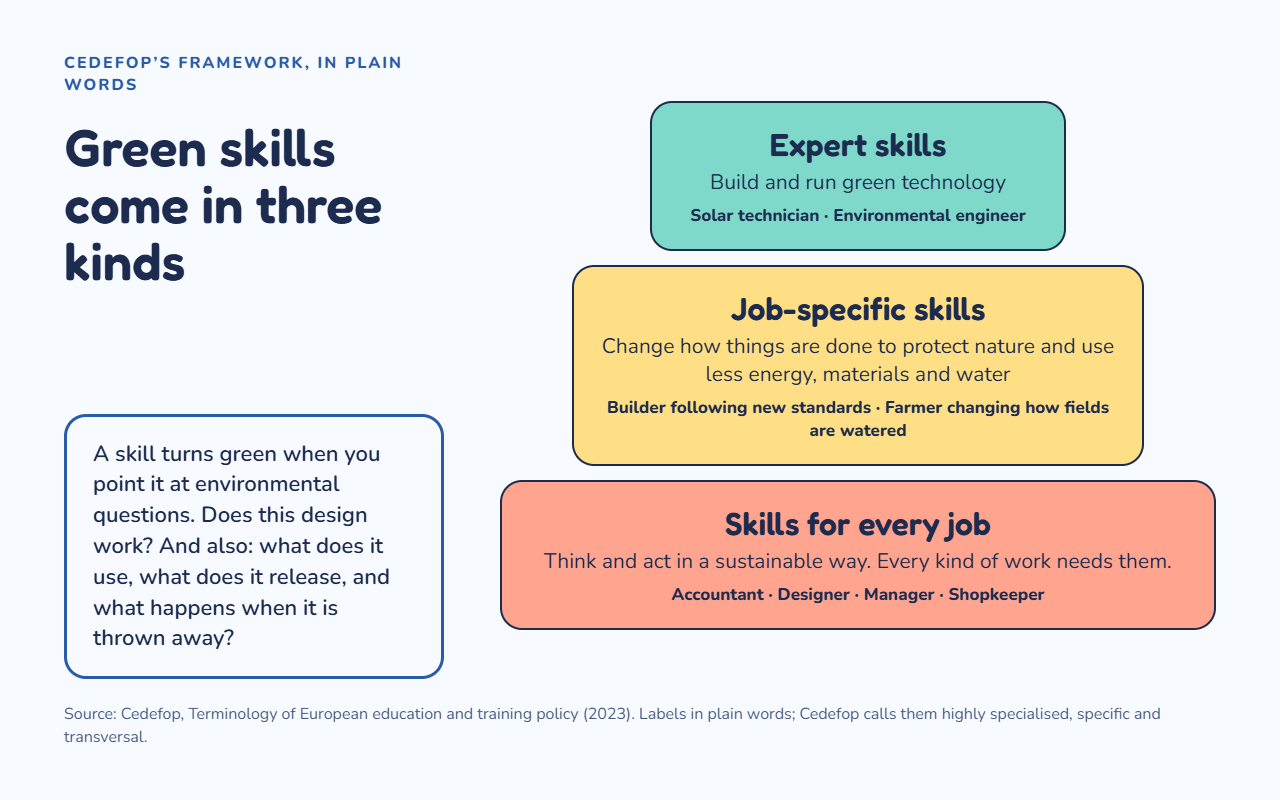
Cedefop, a European agency that studies jobs and skills, describes green skills as the knowledge, abilities, values and attitudes people need to live and work in ways that reduce their impact on the environment.
Put simply, green skills help us understand how our choices affect the planet and what we can do differently.
They can be grouped into three broad types:
1. Skills for specialised green jobs
These are the technical skills needed to develop and operate things such as renewable energy systems, recycling facilities and wastewater treatment plants.
For example, a solar technician needs to know how to install and maintain solar panels.
2. Skills for making existing jobs greener
These are skills that help people change the way they work to use less energy, water and materials, and create less waste.
For example, a farmer might learn new ways to water crops, or a builder might use materials that help keep a building cool.
3. Skills that can be used in almost any job
These help people consider the environmental impact of their choices, solve problems and find better ways of doing things.
For example, an engineer might ask not only whether a product works, but also how much energy it uses, what materials go into it and what happens when it is no longer needed.
A shopkeeper deciding which products to stock can think about packaging and waste. A designer can consider whether something can be repaired instead of thrown away.
These are not entirely new abilities. Problem-solving and creative thinking have always mattered. What makes them part of green skills is using them to understand and respond to environmental challenges.
The World Economic Forum’s Future of Jobs Report 2025 also points to the growing importance of environmental stewardship, or looking after the environment. For the first time, it included this among the ten fastest-growing skills identified in its report.
The report also highlights skills such as creative thinking, flexibility and lifelong learning. These matter because the world of work will keep changing, and people will need to keep learning how to respond.
Green skills are not about knowing all the answers today. They are about learning to ask the right questions and finding ways to act on them.
We need people who understand climate science, renewable energy and environmental engineering. But we also need people in other professions to understand how their work affects the planet.
A greener economy does not mean everyone needs to work in the environment sector. It means people need to understand how environmental challenges connect to their own work.
What does this mean for education?
If green skills are taught only when someone chooses a sustainability course or starts a job, we are leaving it too late.
Children do not need to learn carbon accounting or become experts in renewable energy. But they can start building the habits that will help them understand and respond to environmental challenges later in life.
For example:
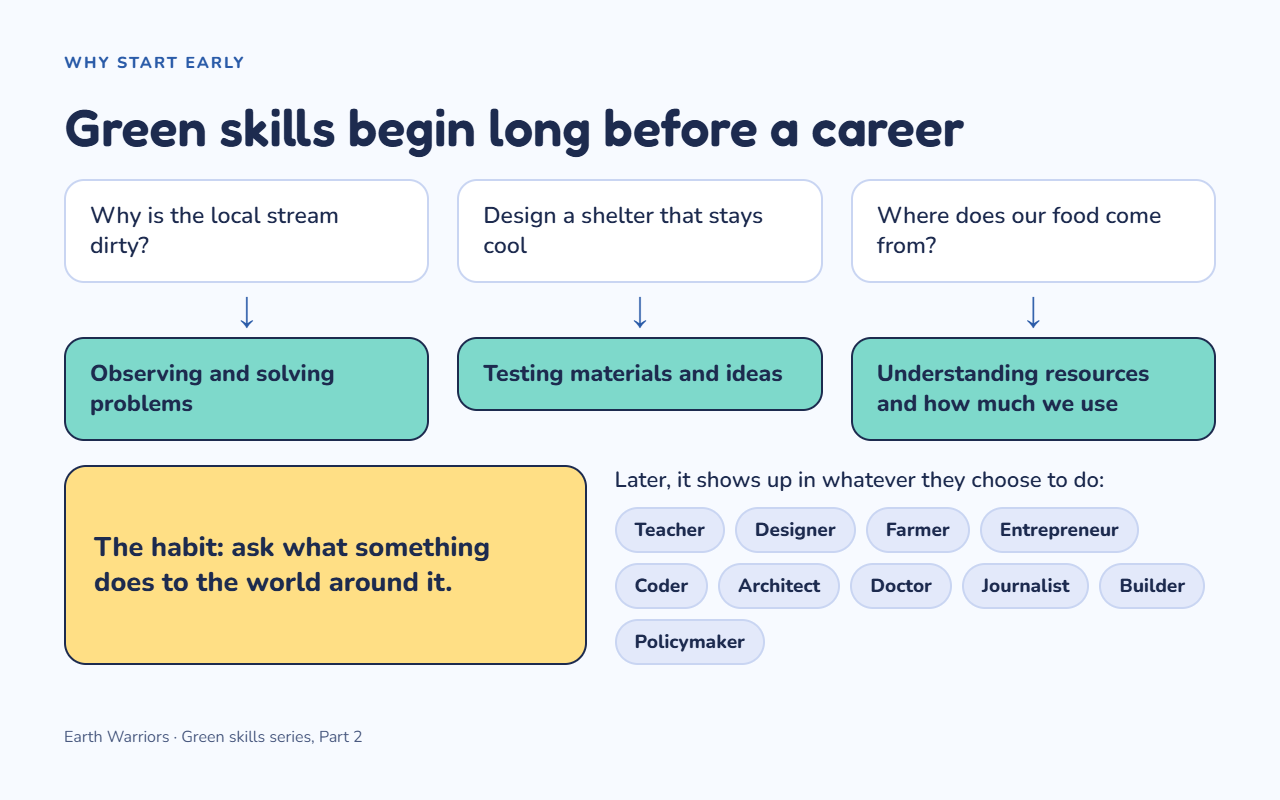
- A child investigating why a nearby stream is dirty is learning to observe, ask questions and look for solutions.
- A child designing a shelter that stays cool is exploring materials, testing ideas and learning from what works.
- A child asking where food comes from is beginning to understand natural resources, how food reaches us and what happens when we waste it.
These activities are not job training. They help children make connections between what they see around them and the wider world.
Over time, these experiences can help children learn to think about the environment when they solve problems, make decisions and work with others.
This is one reason climate education matters from an early age. It gives children opportunities to explore environmental challenges, understand how they affect people’s lives, and discover that there are ways to respond.
The aim is not to tell children which green job to choose. It is to help them understand the world they are growing up in and prepare them to shape it.
Preparing the next generation means looking beyond green jobs
Instead of asking only, “How do we get more young people into green jobs?”, we need to ask:
How do we prepare every young person for a world where sustainability will shape the work they do?
That means creating a stronger link between climate education, green skills, further study, training and decent work.
It also means helping young people see that they can contribute to climate solutions in many different ways. They might become teachers, designers, farmers, entrepreneurs, software developers, architects, doctors, journalists, builders or policymakers.
Their careers may look very different. But the ability to understand environmental challenges and make informed choices can help them all.
And that learning can begin long before they choose a career.
The green workers of tomorrow will not all have chosen a green job. Many will be people who learned to think about the environment in whatever work they chose to do.
In the next piece, we explore what this means for children and schools: which green skills children can start building early, and how climate education can help lay the foundation for the future of work.
Sources
- World Bank, “Equipping India’s workforce for the green transition” (Andrés Ham, Emmanuel Vazquez and Monica Yanez-Pagans, January 2025)
- Ham, Vazquez and Yanez-Pagans, “Characterizing Green and Carbon-intensive Employment in India”, World Bank Policy Research Working Paper 10927 (2024)
- Cedefop, “Skills for the green economy”, in Terminology of European education and training policy (2023)
- UNESCO-UNEVOC TVETipedia, “Green skills” (citing the European Commission’s Skills Panorama, 2015)