
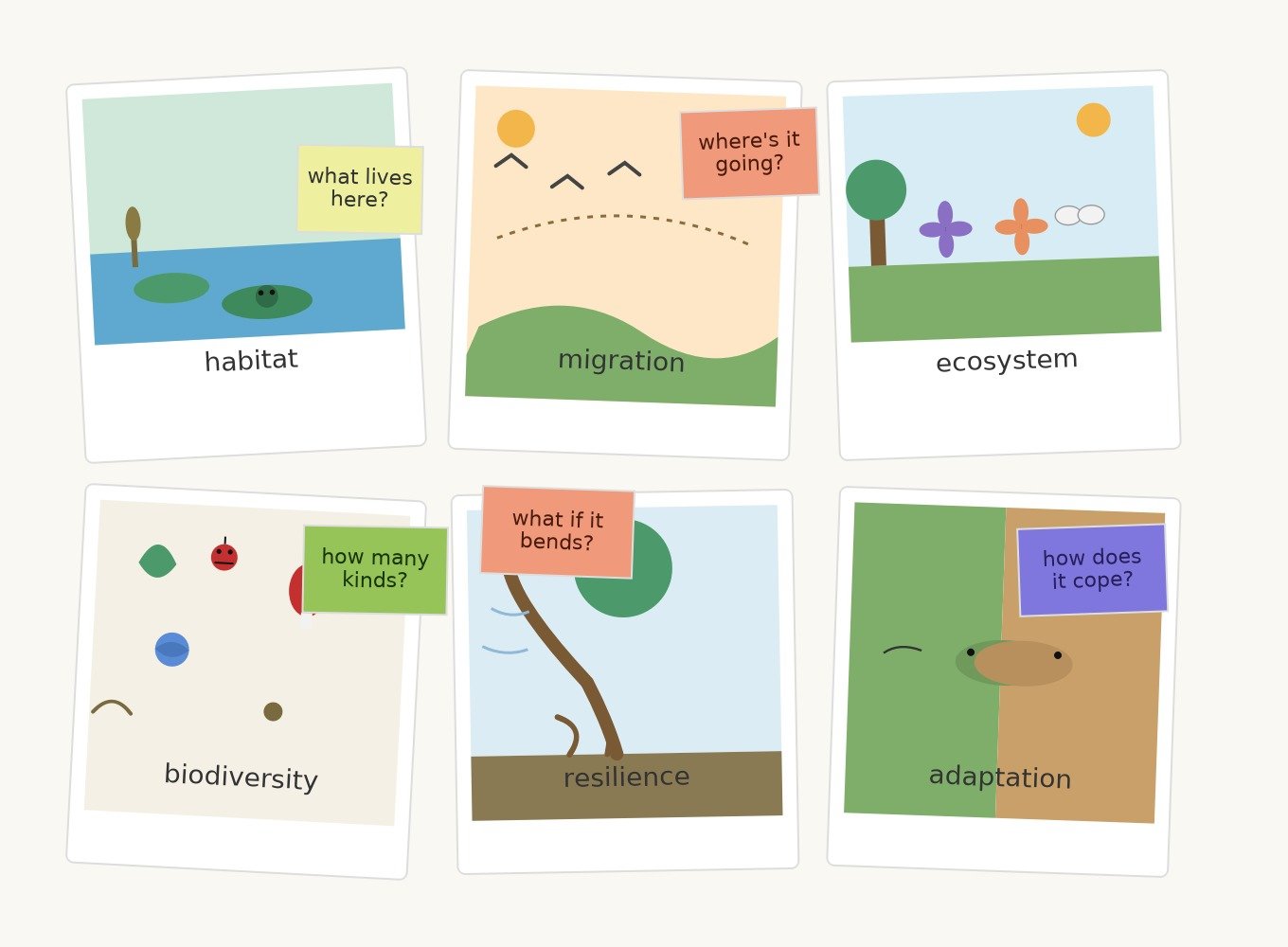
Climate education comes with its own vocabulary: migration, mobility, habitat, ecosystem, biodiversity, resilience, adaptation.
For educators and practitioners, these words can feel familiar. But for a young child, simply knowing that “migration means moving from one place to another” does not necessarily mean they understand migration.
The real challenge is: How do we make these ideas meaningful, concrete and relevant to children?
And there is a second challenge that is just as important: How do we communicate these concepts across different languages and cultural contexts, where a direct translation may not carry the same meaning?
For anyone designing climate learning experiences for children, these are not small communication details. They can shape whether a child remembers a definition—or develops a way of understanding the world around them.
1. Start with what children can see, touch and experience
Technical vocabulary becomes easier to understand when children can connect it to something familiar.
Take habitat.
Instead of beginning with a definition such as “the natural home of an organism,” we can begin with a place children already know—a pond, a garden, a tree, a neighbourhood park.
Ask:
- What lives here?
- What do these animals need?
- Where do they find food and water?
- What happens if the water becomes polluted?
- What happens if the pond disappears?
The word habitat can then be introduced as a way of describing the place and conditions that allow living things to survive.
The same approach can work with migration.
Rather than asking children to memorise that migration is “movement from one place to another,” start with a bird.
Where is it going?
Why does it move?
What does it need along the way?
What happens if one of the places it depends on changes?
The definition still matters—but it comes after the experience and questions, rather than replacing them.
2. Use stories and local examples to explain systems
Some climate concepts are particularly difficult because they describe relationships rather than individual things.
Consider ecosystem.
A child may be able to repeat that an ecosystem is a community of living organisms interacting with their environment. But a much more powerful way to introduce the idea might be to look at a single tree.
Who uses the tree?
Birds may nest in it. Insects may feed on it. Its roots interact with soil and water. It provides shade for people and shelter for other organisms.
Suddenly, ecosystem becomes a story about relationships and connections.
The same applies to resilience and adaptation.
A school might provide shaded spaces during extreme heat. A farmer might change planting dates when rainfall becomes less predictable. A community might improve drainage to prepare for heavier rainfall.
These examples allow children to ask:
What changed? What did people do? Why did they do it? Did it help?
This makes technical vocabulary something children can investigate rather than simply memorise.
3. The same word does not always work the same way in every language
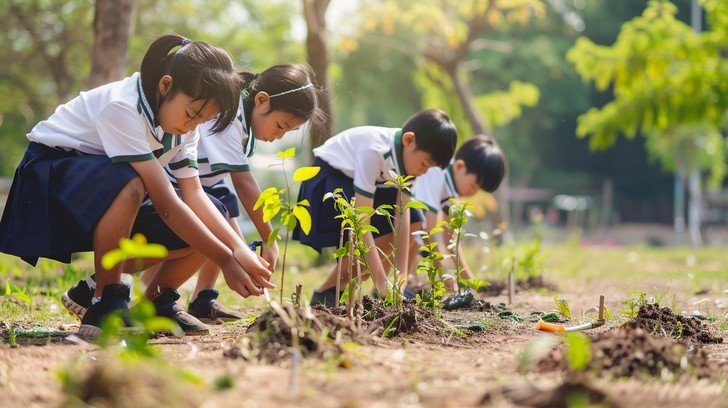
There is another layer to this challenge: translation.
Climate vocabulary is often developed in technical or academic contexts, but children encounter these concepts through their own languages, communities and lived experiences.
A word may have a direct translation in another language, but that does not necessarily mean the concept carries the same meaning.
For example, resilience can be difficult to communicate because it is not simply about “bouncing back.” In one context, children might understand it through how a family prepares for a flood. In another, it might be better understood through how a community responds to drought or extreme heat.
Similarly, mobility can refer to people moving, animals moving through landscapes, or species shifting in response to environmental change. The most useful way to explain the concept may therefore depend on the local context and the examples that children recognise.
This is why climate education cannot always rely on word-for-word translation.
Sometimes, the better approach is to ask:
What is the idea we are trying to communicate?
And then:
What story, example, image or experience would help a child understand that idea in their own context?
4. Let the local context do some of the teaching
Children do not need to begin with global climate terminology.
A child living near a wetland may understand habitat through the birds, fish and plants around them.
A child experiencing seasonal flooding may understand resilience through how their family or school prepares.
A child observing birds arriving at a particular time of year may have a starting point for understanding migration.
A child living in a city experiencing extreme heat may understand adaptation through shade, water, ventilation or changes to outdoor activities.
These local entry points make technical ideas less abstract—and allow educators to introduce the vocabulary once children already have something concrete to connect it to.
A simple shift for climate educators
When introducing environmental vocabulary, it can help to move through three steps:
1. Start with the familiar.
What can children see, experience or investigate around them?
2. Introduce the concept.
What technical word helps describe what they are observing?
3. Connect it to a bigger system.
What does this example tell us about people, nature and a changing climate?
For example:
A pond → habitat → what happens when habitats change?
A bird’s journey → migration → what happens when places along the journey change?
A school responding to extreme heat → adaptation → who can adapt, and what makes adaptation possible?
The goal is not to avoid technical vocabulary. It is to give children a reason to understand it.
Three takeaways for designing climate learning
Make it concrete.
Use places, people, animals and experiences children already recognise.
Translate the idea, not just the word.
A technically accurate translation may still be difficult for a child to understand. Stories, examples and local expressions can sometimes communicate the concept more effectively.
Move from words to relationships.
Climate concepts rarely exist in isolation. Help children see how habitats, biodiversity, migration, resilience and adaptation connect to one another.
Climate education is not about giving children a longer list of environmental terms to remember.
It is about giving them language to notice, question and make sense of the world around them.
Sometimes, the best way to teach a technical word is to start without the word at all—with a place, a story, a question or something a child has experienced.
And then, when the right moment comes, give that idea a name.