
Part 1 of a series on climate education, green skills, and the next generation
Somewhere right now, a child is deciding what she wants to be when she grows up. Whatever she names, the job itself will look very different by the time she gets there, and some of the roles she’ll eventually choose between haven’t been invented yet. The economy she’s about to inherit is being rebuilt in real time, by the climate, by AI, by forces that move faster than any curriculum. And most of our classrooms are still teaching her for a world that’s already halfway out the door.
At Earth Warriors, we teach climate change and sustainability to children aged 3 to 11, through play, positivity, and a solutions-focused lens. We’ve always believed that’s about more than understanding a problem. It’s about handing children the confidence to meet the world they’re growing into, rather than the one we grew up in. This is the first in a series on how that world of work is changing, and what climate education can do to help young people meet it with curiosity instead of dread.
A Different Kind of Economy Is Already Under Construction
Climate change used to sit at the edges of the economy, a subject for the environment page, not the business page. Not anymore. It now sits inside the boardroom, the balance sheet, and the building codes. Every industry that touches energy, materials, land, or transport, which is to say nearly every industry, is being redrawn around what sustainability now demands of it.
The scale of that redrawing is hard to overstate: the World Economic Forum expects the shift toward a greener, more digital economy to help generate a net 9.6 million new jobs worldwide by the end of the decade. Numbers that large can feel abstract. What they mean, in practice, is that the industries a child grows up admiring like construction, farming, transport, finance are quietly becoming green industries whether anyone announces it or not.
Sustainability Is Becoming Everyone’s Job
This is where the old idea of a “green job” starts to fall apart. The green economy isn’t a handful of new eco-careers bolted onto the existing one.
LinkedIn’s latest Global Green Skills Report found that most people hired for their green skills last year weren’t environmental specialists at all. They were accountants, marketers, and operations managers who simply understood sustainability well enough to bring it into work they were already doing. Green skills are becoming less like a job title and more like a language, one that’s starting to show up everywhere, the way fluency in data or a second language did a generation ago.
Young People Can Feel the Gap
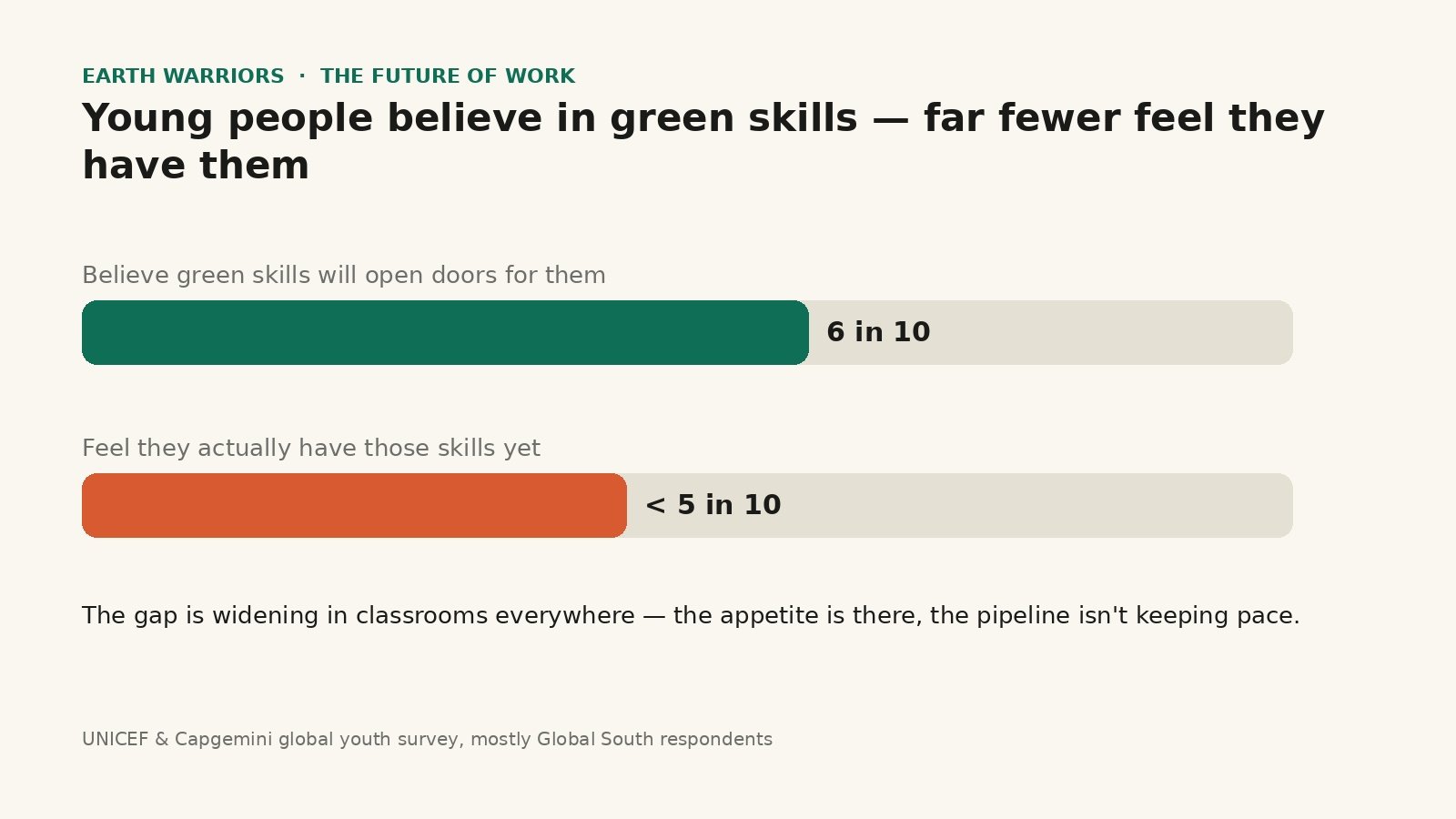
Demand for sustainability know-how is outpacing supply, and the gap is widening in classrooms everywhere, not just in wealthy ones. A global UNICEF and Capgemini survey of young people, most of them in the Global South, found that six in ten believe green skills will open doors for them. Fewer than half feel they actually have those skills yet. The appetite is there. The pipeline isn’t keeping pace.
They care. They Just Can’t See the Path.
Ask young people if they care about the planet, and the answer, almost everywhere you look, is yes. Ask them whether they can see a career connected to that care, and the picture falls apart.
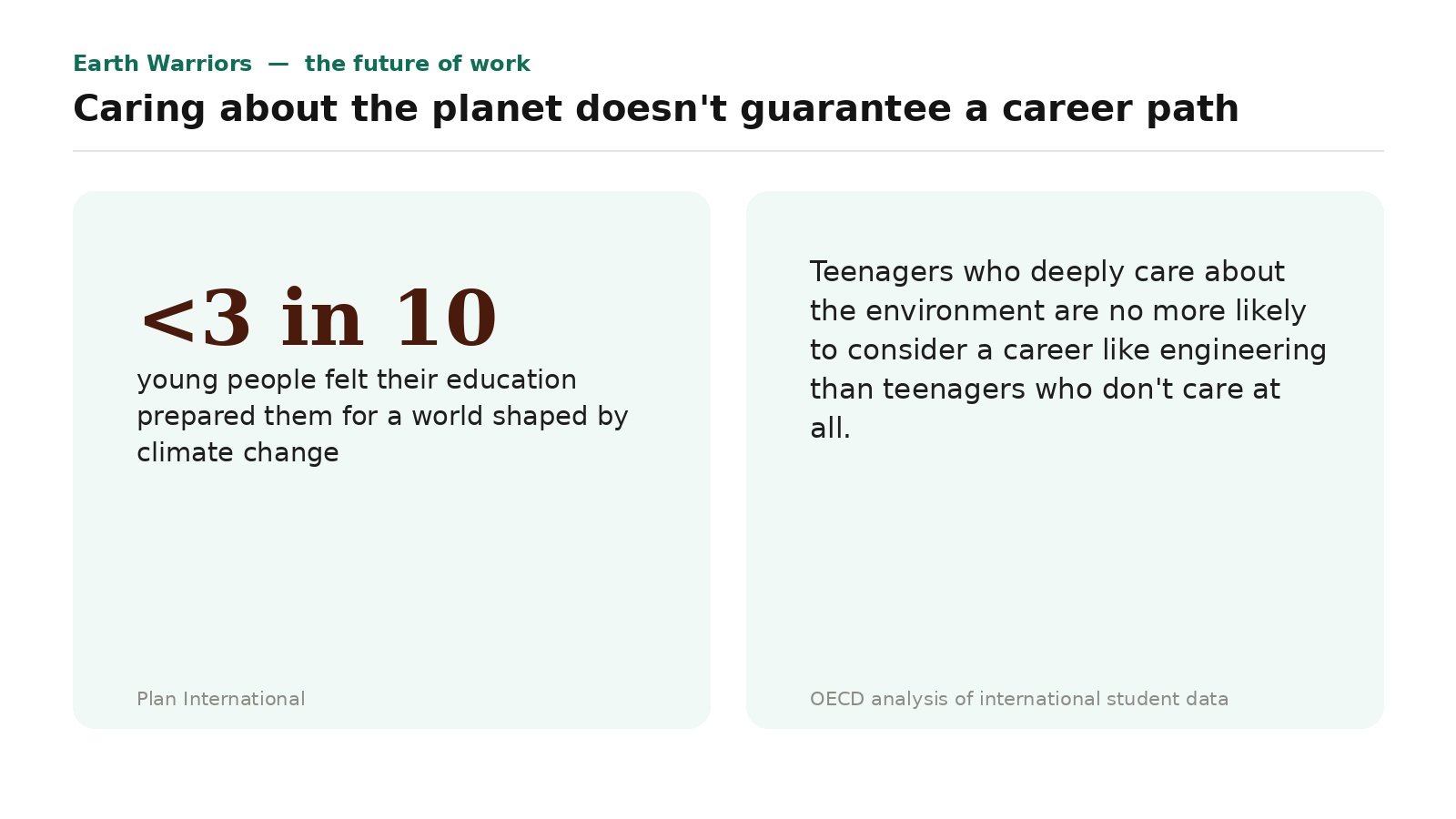
The OECD’s analysis of international student data found something worth sitting with: teenagers who deeply care about the environment are no more likely to consider a career like engineering than teenagers who don’t care at all. The passion is there. It simply hasn’t been shown a door to walk through. A global Plan International survey found that fewer than three in ten young people felt their education had actually prepared them for a world shaped by climate change.
Young people don’t need convincing to care. What they need is someone to connect the dots between the world they already worry about and the work they could do to shape it.
Why Starting Early Changes Everything
Career guidance usually arrives in the teenage years, on the theory that career thinking is a teenage problem. The evidence suggests otherwise. By the time formal guidance shows up, a lot of children have already quietly decided which fields feel like “theirs” and which don’t, often without anyone meaning to teach them that at all.
What we see in early years classrooms is that this decision-making starts far earlier, and far more casually, than most adults assume. Ask a group of six-year-olds who fixes a leaking tap, or who decides what a building is made of, and you learn a great deal about the map of the working world they are already carrying around. Early climate education does not teach children about jobs. It does something more useful. It widens that map, so that caring for the planet sits inside ordinary work, farming, building, cooking, making things, rather than off to one side as something only scientists and activists do.
That’s the gap early climate education can close. A five-year-old who grows up seeing sustainability woven through construction, food, transport, and technology, rather than fenced off as a topic for science class, is far less likely to become a fifteen-year-old who cares deeply about the planet and still can’t picture a place for herself in fixing it.
The Argument, in Short
Climate education was never only about understanding environmental challenges. It’s about giving young people the tools to navigate a world of work being rewritten around them, by climate, by technology, by change itself. The earlier they can see that world clearly, the more confidently they’ll be able to claim their place in it.
The next piece in this series looks more closely at what green skills actually are, and what it takes to build them into education from the earliest years.
Want to bring this kind of climate and sustainability learning into your school? Get in touch with our team at hello@earthwarriorsglobal.com
Sources
- World Economic Forum, Future of Jobs Report 2025 (January 2025)
- World Economic Forum / McKinsey & Company, Making the Green Transition Work for People and the Economy (November 2025)
- LinkedIn Economic Graph, Green Skills Reports and Resources (2025)
- Capgemini Research Institute and UNICEF Generation Unlimited, Youth perspectives on climate: Preparing for a sustainable future (May 2025)
- OECD, Enhancing Green Career Guidance Systems for Sustainable Futures, Education Working Paper No. 318 (2024), drawing on PISA 2018 data
- Plan International / Generation Unlimited, Young people unprepared for jobs in the “green economy”, global survey (2022)